
A Journey of Legend
Online Event Review
Heavenly Road of Life: Dr. Jun Xu of Africa Cries Out
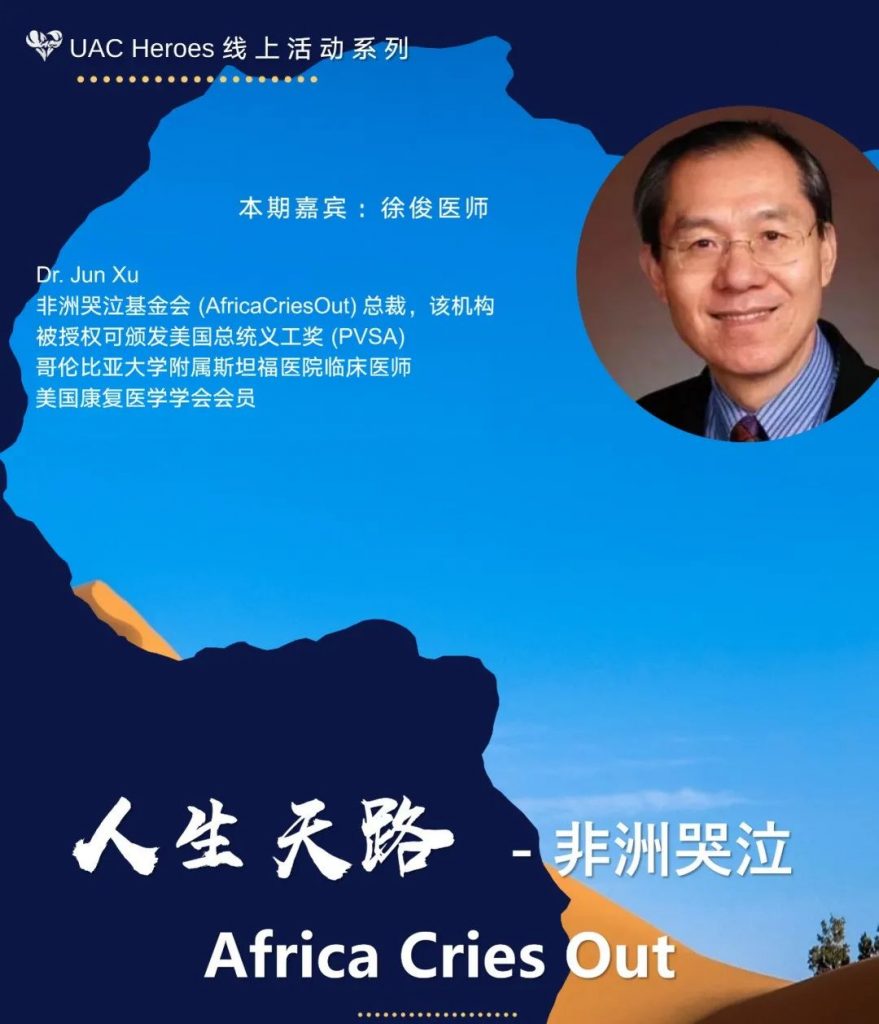
Introduction:
Dr. Jun Xu is licensed in the US both as a physician and as an acupuncturist. He is an attending physician at Stamford Hospital, a Columbia University affiliate, and president of the Africa Cries Out foundation.
For years, he and his team at Africa Cries Out have carried out charitable work in remote leprosy villages in Senegal, West Africa. Since 2013 he has traveled many times to this isolated place to treat the sick and injured, helping to set up a medical clinic and found a technical school. Despite extremely harsh conditions, scarce funds and resources, and even an Ebola outbreak, they have done everything they can to serve their patients. Their work is widely praised in Africa, the US and China, and in recognition Africa Cries Out has been officially authorized to certify volunteer service hours for American volunteers and to present the President’s Volunteer Service Award (PVSA), the highest US honor for volunteer service.
Dr. Xu’s talk was especially moving:
– when he recalled arriving in America with a mere 50 dollars, later building a family and a comfortable life, and so wanting to give back to society with a grateful heart;
– when he told of Ms. Marina, who has worked full time for charity in Africa since 2017, and who two weeks earlier had been kidnapped for the third time – luckily rescued on the spot by kind strangers – yet still insisted on staying in Africa;
– when he showed photos of elderly villagers whose leprosy had numbed their peripheral nerves, so that they never felt the wounds on their arms until infection set in and their hands or arms had to be amputated;
– when he described how Pastor Anna discovered a village the world had forgotten, whose people knew neither their own names nor their dates of birth;
– when he spoke of April 7, 2017: Dr. Faye, already unwell, insisted on traveling from the base to the leprosy village, and on arrival was hospitalized with suspected diabetic ketoacidosis. With 300 leprosy patients waiting for treatment, Dr. Xu had to leave Dr. Faye’s side for a while – and after two hours of work he got a phone call telling him Dr. Faye had died of a heart attack. He wept as though his heart would break;
– when he described hungry children gathering around the medical volunteers at mealtimes and grabbing the chicken bones they had thrown away to eat;
– when he explained that taking children to Africa and to the leprosy villages is not only about community service to help them get into medical school, but about letting them see poverty with their own eyes and reflect on life and its meaning…
Finally, Dr. Xu left us with some thought-provoking questions: What is our purpose in coming into this world? When we leave it, what will we have left behind? Earning a living and raising our children is our responsibility – it is what we do for our families. But if we help others, we are not only taking from the world. When we give even a little – not just for our own children and families, but for the world, for the poor, for those in need – we have made our contribution, and then we can proudly say that we really have left something behind.
If you would also like to hear Dr. Xu’s moving talk, a call to love, please follow the link below. Dr. Xu’s views are his own and those of Africa Cries Out, and do not represent UAC.
Q&A
Here are some of the questions and answers after the talk.
Q: Questions about going to Africa
A:
Budget per person: from the US, the flight is roughly $800–1,000. For food and lodging we charge about $500, since you stay around seven or eight days and need meals and transport. On top of that comes our suggested donation – we buy grain and cooking oil for the local people – of roughly $1,000–1,200. Altogether that comes to about $2,500 per person. All costs are self-funded or covered by sponsorship you raise yourself.
Language: if you want to go, you need some English; French is even better, as it is the official language there.
Visa: holders of mainland Chinese passports should apply for a visa in advance; we can’t guarantee visa on arrival. US passport holders get a visa on arrival.
Is there a limit on group size? In recent years each group has had about thirty-some people. 2019 was the largest, with over forty – even the biggest bus was packed full. The main challenge locally is transport: the leprosy village is about 700 km from our base, a 13–14 hour drive. About ten people from our own team go each year from the US, including volunteers, children and their parents. Right now, because of the pandemic, we cannot go in.
To join a group, should we contact Dr. Xu directly or follow the website? You can contact Dr. Xu directly. Because of the pandemic, it is uncertain when we can go again; before May 2021 seems unlikely, at least while travel from the US is restricted.
When to go: generally between February and May. Africa has two seasons, dry and rainy. The rainy season runs about three months, June to August, and we cannot go then: there are many mosquitoes, which spread malaria, yellow fever, encephalitis and other diseases. In September and October after the rains there are fewer mosquitoes, but still some, so we don’t go then either.
So trips to Africa happen mainly in the first half of the year. In the dry season, February to May, the mosquitoes have basically all died off, because without water they can’t survive. That’s why we always go in this season. Some parents ask whether their children can go during summer vacation – I’m truly sorry, but we can’t, because it would be life-threatening.
Children who join us in the dry season take time off school. We usually leave on a Friday afternoon or evening and return on the Sunday of the following week. The children miss a week of school, but schools are generally understanding.
If we go during spring break, we schedule around most children’s break, since US schools don’t all have spring break at the same time; the few children with conflicts need to arrange time off.
Q: What do the children usually do there?
A: Our youth team has plenty to do there.
First, they help us hand out medicine and take part in the medical work, which makes them feel useful.
Second, they help us with poverty relief and distributing food.
Third, and very important, they take part in our logistics. At breakfast, for example, the children get up earlier than we do. They split into teams: the first prepares that morning’s breakfast, the second prepares the next day’s. At lunchtime they help clear the dishes. This gives them a sense of belonging. That’s why many children on my team have gone for years – three or four years now – and still want to go back, because they know they can contribute something there for the African people and for the team.
Seventh-graders must be accompanied by a parent, either father or mother.
Q: Is there a risk of violence, robbery or theft?
A: Senegal, where we go, is a very orderly country. Its founding president was a Christian, and its later leaders have guided the nation by the most orthodox teachings of the Bible and the Quran, so the country is very well run and the roads and towns are clean. Violent crime isn’t common – I can’t say it never happens – but we don’t go to dangerous places.
Second, wherever we go we are led by local co-workers who know where it is and isn’t safe to go. In all our years of going, we have never once been robbed or had any trouble of that kind. Marina’s case was not in the same country as us – she was in Mozambique.
Q: Why do poor Africans not seek change?
A: That’s why what we do there, bit by bit, is education: teaching them skills so they have a way to make a living, and educating them so they can embrace modern civilization – that is the most important thing. Our goal is to give these people knowledge and ability.
Q: Are there enough pandemic supplies locally? Is there a shortage of shoes? Anything else?
A: Yes, there are shortages. Africa can accept pandemic supplies, but if they are sent from China or the US you have to handle the export paperwork yourself, and on arrival there is an import process with roughly 30% duty – very high.
Daily necessities are also short – shoes, for example. You can also collect older iPhones and laptops: an iPhone 7 or iPhone 8 still works great in Africa, and old laptops can be collected and given to students at these African schools, which is also a way to build a connection with them.
Q: How can we donate to the foundation?
A: We accept donations in RMB; please first contact me on WeChat (Dr. Jun Xu, WeChat ID: jun9174343767; email: africacriesout@gmail.com; WeChat official account: Heavenly Road of Life). Our team in Guangzhou, mainland China, handles RMB donations and has a bank account; the goods in our containers to Africa are all bought with RMB and shipped straight to Africa, so there’s no need to buy with dollars in the US and ship them back.
To donate in US dollars, please visit www.africacriesout.org to give online, or write a check to Africa Cries Out and mail it to Jun Xu, MD, 1171 E Putnam Avenue, Riverside, CT 06878, USA. You will receive an IRS-recognized tax-deductible receipt.
Q: What help does Dr. Xu need most right now?
A: First, help applying for grants, including government grants. We are applying for US government grants, and those need a dedicated grant writer – someone with strong English writing skills would be a great help.
Second, I have a WeChat official account, but I really don’t have the energy to keep it updated. If someone were willing to help run it, that would be enormous support for me. (Baohan has since started helping with this.)
Thank you all!
Recent Comments